Edmond’s Only Rodent-Focused Service
Rodent Control Edmond OK
We find how they’re getting in, seal it shut, and remove every rat and mouse — not just the ones you see.
✅ Serving 73003 · 73012 · 73013 · 73025 · 73034 · 73083
✅Licensed — ODAFF Category 7B Structural Pest & Termite
✅ Same-day when you call before noon
✅ Rodent control only — not a general pest plan
Why Edmond Is Different
Why Rodent Control in Edmond, OK Is a Year-Round Problem
If you’ve heard scratching behind your walls or found droppings in a kitchen drawer, you’re not dealing with a fluke. Rodent control in Edmond, Oklahoma has a specific set of problems that most general pest companies aren’t set up to explain properly, let alone fix permanently.
The ground under your home is part of it. Edmond sits on Oklahoma’s expansive clay belt — the Grumman and Tabler soil series that shift with every rain cycle and every dry summer stretch. When Edmond gets its annual 36 inches of rainfall and then bakes at 93°F for weeks in July, the clay shrinks. That movement opens gaps in foundations, pulls apart utility penetrations, and separates soffit material from framing. Those gaps aren’t visible from the outside. A Norway rat (Rattus norvegicus) finds them in hours.
The trees are part of it too. Edmond’s mature oak neighborhoods — Hafer Park, Oak Tree, the streets near E.C. Hafer Park along 15th Street, the Coffee Creek corridor — have canopies that roof rats (Rattus rattus) use as travel highways into homes. . A roof rat runs along an oak branch, drops onto your roofline, and squeezes through a damaged soffit vent before you’d notice anything from the ground.
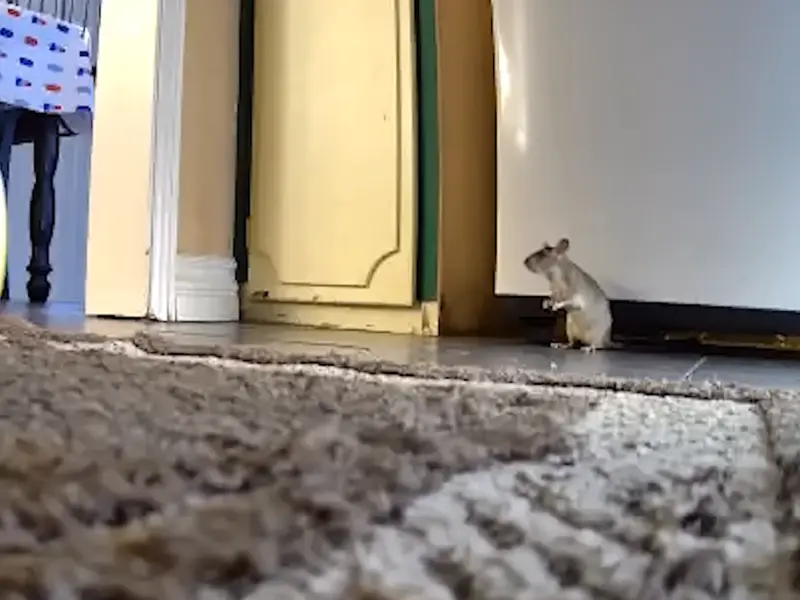
And Oklahoma’s weather drives two separate surges every year. Rodent calls in Edmond spike from June through August when the population explosion from spring litters pushes young rodents toward cooler structures. Then calls spike again from October through February when Oklahoma’s cold snaps send every rodent searching for warmth. Northwest Edmond and the Deer Creek corridor have seen the highest call volumes — documented by KFOR News and confirmed by local pest control companies operating in Oklahoma County.
In our own Edmond inspections, Norway rat entry points at foundation weep holes and clay-soil expansion cracks account for the majority of rat problems in Deer Creek and North Edmond. For roof rats in established neighborhoods like Hafer Park and Oak Tree, an open soffit gap within reach of an overhanging oak branch is the entry point in nearly every job we run.
Most companies in the OKC metro treat rodents as one line item on a general pest plan. We don’t. Rodent control in Edmond is all we do, and that focus shows in every inspection and every job we close.
Hearing something in your walls? Call (405) 507-4458 — same-day service available.
Real Job — Experience Signal
What a Real Edmond Rodent Inspection Looks Like
Last October, a homeowner near Hafer Park called us after three weeks of ceiling scratching — always starting around 10 p.m. and running until just after midnight. She’d set two snap traps in the attic and caught nothing. When we got there, we found a roof rat entry at a damaged soffit corner directly below an oak branch that extended within two feet of the roofline. The entry gap was about the size of a golf ball — 40 feet off the ground, completely invisible from the driveway.
Inside the attic: two active nesting sites in the blown-in insulation, shredded electrical wire insulation near the HVAC flex duct connection, and concentrated droppings indicating a population that had been there for at least six to eight weeks. The traps she’d set were in the wrong locations — placed in open attic space rather than along the wall runs where roof rats travel. Roof rats follow the same routes every night. Traps set away from those runs go untouched.
We sealed the soffit entry with galvanized hardware cloth secured with screws, pre-baited the activity runs for four days, then set traps at the correct locations. Confirmed clearance on the third follow-up visit twelve days later. She got an electrician to check the wiring before we closed the job — which is the right call any time we find gnaw damage near active circuits.
That job is Edmond in one story: the right species identification, the right entry point, the right trap placement, and the electrical check no one else told her about.
Species Identification
Which Rodent Is in Your Edmond Home?
Getting the species right changes everything about how treatment is done. A trap placement strategy that works for house mice will frustrate a Norway rat for a week. Here’s what’s active in Edmond right now.
Norway Rat (Rattus norvegicus)
The brown rat. Heavyset, blunt nose, bicolor tail shorter than its body — up to 10 inches long plus a 7-to-9-inch tail. In Edmond, Norway rats show up most in newer subdivisions in Deer Creek (zip codes 73025 and 73034) and along the northern expansion corridor near Memorial Road. They burrow. Foundation weep holes, gaps at utility entries, and the expansion cracks that Edmond’s Grumman and Tabler clay soil produces every dry summer — these are their highways.
Norway rats are neophobic. They avoid new objects placed in their territory for three to seven days before approaching them. Set a snap trap the day you spot a Norway rat and you may wait a week for a catch. That’s why pre-baiting — placing unset traps with bait for several days before setting them — is a required step in any professional Norway rat protocol. Most DIY attempts fail here because homeowners set traps immediately.
What Edmond homeowners report:Burrow holes appearing along exterior foundation walls. Chewing damage near pipes below sinks. Droppings in basements, crawl spaces, or garage corners. Dark grease rub marks along baseboards at floor level.
Roof Rat
The black rat. Sleek body, large ears, tail longer than its body — 6 to 8 inches long. Roof rats are climbers. In Edmond, the neighborhoods with mature oak canopy — Hafer Park, Oak Tree near NW 164th and May, the older streets off Coffee Creek Road, properties adjacent to Spring Creek Park — see the most roof rat activity. They travel branch to roofline, find a soffit gap or open HVAC penetration, and move straight into attic insulation.
Once in an Edmond attic, roof rats chew through electrical wiring, saturate insulation with urine, and nest in wall voids.
They follow fixed travel routes every night — which is why trap placement off those routes produces nothing, and placement directly on those routes produces results fast.
What Edmond homeowners report:Ceiling scratching that starts at dusk and runs until after midnight. Spindle-shaped droppings in the attic or near upper cabinets. Chewed wiring discovered during HVAC service calls. Damaged soffit material visible from a ladder.
House Mouse
The most common rodent we treat in Edmond homes. House mice enter through gaps as small as a quarter-inch — the width of a standard pencil. They breed fast: a single female produces 6 to 10 litters per year under favorable conditions, with 4 to 7 pups per litter. A two-mouse problem in October becomes a colony by January if nothing is done.
House mice are curious about new objects, unlike rats — they’ll investigate a trap within 24 hours of placement. That makes them faster to catch, but the high reproduction rate means trapping without exclusion is a losing race. Around the University of Central Oklahoma corridor — older homes along Broadway and 2nd Street, student rentals near the campus — house mice are a recurring problem tied directly to aging construction and frequent tenant turnover.
What Edmond homeowners report:Small dark droppings along baseboards and inside kitchen drawers. Chewed food packaging in pantries. Urine smell near nesting areas in wall voids or attic insulation. Scratch marks on drywall near floor level.
🔍 Not sure which species you have? We identify it in the first inspection — Call (405) 507-4458
How We Compare to Local Pest Companies
We’re not being modest — Edmond homeowners deserve to see the real differences before they call anyone.
Our Process
How We Handle Rodent Problems in Edmond Homes
There is one correct sequence for rodent control. Skip any step and the problem comes back. Every job we run in Oklahoma County follows this order.
1. Full Property Inspection
We start by asking three questions: where are they getting in, what species are we dealing with, and how established is the population? The inspection covers the full exterior — foundation line, roofline, soffit, fascia, utility penetrations, HVAC lines, and garage door seals. Then inside: attic, crawl space, and any areas where sound activity has been reported.
We look for rub marks — the grease streaks rats leave at entry points from the oil in their fur. We measure gaps at foundation weep holes. We check where oak tree branches come within four feet of the roofline. In every Edmond inspection, we check the foundation perimeter specifically for the expansion cracks that Grumman and Tabler clay soils produce during Oklahoma’s dry summers — cracks that often don’t exist in spring but open by August.
The inspection drives everything. Treatment without a thorough inspection is guesswork.
2. Exclusion — Sealing Every Entry Point
This is the step most companies skip or price too low. Trapping removes rodents already inside. Exclusion stops the next wave.
For foundation gaps and weep holes, we pack copper mesh and steel wool firmly into the gap before sealing with appropriate caulking. For larger structural gaps — pulled-away soffit panels, open utility penetrations at the roofline — we use galvanized hardware cloth secured with screws, not staples. Stapled mesh pulls away within one season in Oklahoma’s temperature swings.
We also recommend trimming oak and other mature trees to maintain at least a four-foot gap between branch tips and your roofline. Roof rats cannot leap more than four feet horizontally. That one yard maintenance task eliminates the most common roof rat entry pathway in Hafer Park, Oak Tree, and Coffee Creek neighborhoods.
Foam caulk alone is not an exclusion material. Rats and mice chew through it in hours. Any company using foam as a primary exclusion sealant is not providing a permanent solution.
3. Trapping and Removal
We don’t use rodenticide inside structures. Poison kills rodents inside wall voids. A single Norway rat decomposing inside your wall produces a powerful odor that lasts six to eight weeks — and finding it means opening drywall. We use snap traps and tamper-resistant bait stations placed at activity zones identified during the inspection.
For Norway rats, we pre-bait for three to five days before setting traps to account for neophobic behavior. For house mice, trap placement at 10-foot intervals along active runways near entry points and baseboards is what gets results. We return to check, remove, and reset until all activity stops.
4. Attic Cleanup and Sanitization (When Needed)
Rodents contaminate insulation with urine, feces, and pheromone trails that attract new rodents long after the original population is gone. In Edmond, attic temperatures reach 140°F in July — that heat concentrates and volatilizes particles from accumulated rodent waste, which affects air quality throughout the home.
The CDC documents that hantavirus pulmonary syndrome (HPS) spreads through breathing disturbed particles from rodent droppings and urine. Oklahoma health officials have confirmed hantavirus cases in the state, and PubMed research documents hantavirus-carrying rodents across Oklahoma. Contaminated attic insulation should never be disturbed without N95 respiratory protection, gloves, and eye protection at minimum — and in serious infestations, removal and replacement is the right call.
We offer attic cleanup and insulation assessment as a standalone service for homeowners who have already treated the rodent problem but are concerned about what was left behind.
5. Follow-Up and Clearance Confirmation
We schedule a follow-up visit after initial treatment to confirm activity has completely stopped, verify all exclusion work is holding, and check for any secondary entry points that weren’t accessible during the first inspection. We don’t consider a job finished until a follow-up visit confirms zero active signs — no fresh droppings, no new rub marks, no sound activity.
Most Edmond mouse jobs resolve in one to three visits. Norway rat jobs with full exclusion typically take two to four weeks from first visit to confirmed clearance.
Ready to start? No Poison Inside Your Home · Child & Pet Safe Protocols Call (405) 507-4458
What’s At Stake
What an Untreated Rodent Problem Does to Your Edmond Home
Homeowners who wait almost always say the same thing afterward: they had no idea how fast it escalated. Here’s what’s happening inside an untreated home right now.
⚡ Electrical Fire Risk
Rodent incisors grow 4 to 5 inches per year — they gnaw constantly to wear them down. According to the NFPA and fire investigation professionals, rodents chewing through wiring account for an estimated 20 to 25 percent of house fires with undetermined causes — approximately 20,000 fires per year in the United States. If you find rodent activity in your attic and gnaw marks on any wiring, get an electrician to inspect before you do anything else.
⚠️ Food Contamination
The CDC documents that rats and mice spread more than 35 diseases worldwide. Salmonella is transmitted through rodent droppings that contact food surfaces or stored food. Leptospirosis spreads through contact with urine-contaminated water or surfaces. You don’t need to see a rodent to be exposed — dried droppings on a pantry shelf or urine tracked across a countertop is enough.
🏠 Structural Damage
Norway rats chew through drywall, plastic pipe, and soffit material to expand their burrows and runways. Roof rats damage soffit boards, HVAC flex duct, and attic insulation. Repair costs in a seriously infested home run from a few hundred dollars to several thousand, depending on what they’ve reached and how long the infestation ran.
💨 Indoor Air Quality
At 93°F+ Edmond summer temperatures, contaminated attic insulation becomes an indoor air quality issue as the heat concentrates rodent waste particles. Rooms directly below an active attic infestation are most affected — this is not something most homeowners think about until they’re already dealing with it.
Licensed, Local, Rodent-Only
Licensed, Local, and Focused on Rodents
Every credential we list, you can verify in 30 seconds.
Oklahoma ODAFF Category 7B Licensed
Every technician working in your home holds a current ODAFF Commercial Applicator License, Category 7B Structural Pest and Termite, issued by the Oklahoma Department of Agriculture Food and Forestry at 2800 North Lincoln Blvd., Oklahoma City — as required by Oklahoma state law. You can verify any Oklahoma pest control license directly at the ODAFF Consumer Protection Services portal.
Rodent Specialists, Not Generalists
We don’t split our attention across 40 pest types on a general contract. Norway rat behavior, roof rat entry point patterns, house mouse runway identification, exclusion material performance in Oklahoma’s climate — this is what we study and practice. Rodent control in Edmond is all we do.
Built on OSU Extension Guidelines
Our inspection and treatment protocols align with the Oklahoma State University Cooperative Extension recommendations for structural rodent management in central Oklahoma’s climate and soil conditions. OSU Extension’s pesticide safety education program (127 Noble Research Center, Stillwater, OK 74078) provides the research baseline for our species-specific treatment protocols.
No Poison Inside Your Home
We don’t use anticoagulant rodenticide inside occupied structures. Rodenticide inside a home creates dead rodents in walls, ceilings, and crawl spaces — and the decomposition odor from one Norway rat in a wall void lasts six to eight weeks. Snap traps and tamper-resistant exterior bait stations are the correct tools. We explain everything we place and where before we leave.
Child and Pet Safe
All interior trapping uses enclosed or tamper-resistant trap housings that children and pets cannot access. We provide written documentation of all trap locations at every service visit.
Our Service Areas
73025 · 73034
Newer construction near open land. Edmond’s clay soil opens foundation gaps in homes from the 2000s and 2010s before homeowners know they exist.
73034
Dense oak canopy around E.C. Hafer Park gives roof rats a direct highway to rooflines. Aged 1980s soffit material makes entry easy.
SW Edmond · NW 164th
Golf community with mature tree canopy and large lots. Roof rats at the roofline and Norway rats at the foundation — sometimes in the same home.
73034 · 73025
Year-round moisture from Coffee Creek and Spring Creek sustains rodent populations in the adjacent green space. Higher pressure than drier areas of Edmond.
73003 · 73034
Older construction around the UCO campus on Broadway and 2nd Street. Aging seals and student rental turnover create year-round house mouse pressure.
73003 · 73012
Newer development along NW 150th–185th Street corridor. Norway rat pressure from Arcadia Lake wildlife corridor and open land near Mitch Park.
Our Rodent Control Edmond OK Services
Rat Control
Edmond homes and businesses face serious threats from Norway rats and roof rats — especially near drainage ditches, older neighborhoods, and commercial dumpsters. Our rat control service includes thorough inspection, tamper-resistant bait station placement, entry point sealing, and follow-up monitoring to make sure the infestation is fully eliminated, not just temporarily reduced.
Mice Removal
House mice squeeze through gaps as small as a quarter-inch and breed year-round. Two mice in October become twenty by January. We find every entry point, seal it shut, and clear the colony completely — not just the ones you see.
Rodent Exclusion
Most companies trap. We seal. Copper mesh, galvanized hardware cloth, and a full inspection from foundation to roofline — every entry point closed permanently.
Aatic Cleanup
Rodents don’t just leave your attic — they leave behind contaminated insulation, urine-soaked nesting material, and pheromone trails that attract the next infestation. We remove it all, sanitize the attic deck, and restore insulation to Oklahoma’s R-38 standard.
Rodent Inspection
Not sure what’s in your walls or attic? We inspect your full Edmond home — foundation to roofline — identify the species, map every entry point, and give you a written findings report before we recommend anything.
Common Questions Answered
How Do I Know If I Have Rats or Mice in My Edmond Home?
The fastest identification method: look at the droppings. House mouse droppings are 3 to 6 millimeters long, smooth, dark, and pointed at both ends — about the size of a grain of rice. Norway rat droppings are 18 to 20 millimeters, blunt-ended, and capsule-shaped — roughly the size of a large raisin. Roof rat droppings are similar in size to Norway rat droppings but pointed at both ends.
Beyond droppings, listen for sounds: house mice produce light scurrying and occasional scratching that can happen any time of day. Norway rats in a foundation or crawl space create heavier thumping sounds at ground level. Roof rats in an Edmond attic produce scratching and rolling sounds above the ceiling from dusk to midnight — they’re strict night movers. Rub marks — dark grease streaks at entry points from the oil in a rat’s fur — confirm rat activity specifically. A licensed inspection confirms species, population size, and all entry points before any treatment starts.
Why Do Rodents Keep Coming Back After I Set Traps?
Traps catch individual rodents. They don’t close the entry points that let new rodents in. In Edmond, the Grumman and Tabler clay soil beneath most homes shifts seasonally — expanding after rain, shrinking in Oklahoma’s dry summers — continuously reopening foundation gaps that were sealed or nonexistent in spring. A house mouse exploits a new quarter-inch gap within hours of it forming. A Norway rat will chew an existing small gap wider. Without exclusion work — physically sealing every entry point with copper mesh, steel wool, galvanized hardware cloth, and caulking applied over those materials — traps are an ongoing maintenance program, not a permanent solution.
The correct professional sequence is always inspection first, exclusion second, trapping third. Homeowners who start with traps and skip exclusion will be resetting those traps indefinitely. The rodent populations in the fields near Deer Creek development corridors and along the creek corridors near Arcadia Lake are not going to decline on their own.
Is It Dangerous to Have Rodents in My Edmond Attic?
Yes — for three specific reasons. First, electrical fire risk: rodent incisors grow 4 to 5 inches per year and gnawing is how they manage that growth. Wiring insulation is a consistent target. Fire investigation professionals attribute 20 to 25 percent of house fires with undetermined causes to rodent gnawing — approximately 20,000 fires per year nationally. Second, health risk: the CDC confirms hantavirus pulmonary syndrome spreads through breathing disturbed particles from rodent droppings and urine.
Oklahoma health officials have confirmed historical hantavirus cases in the state, and the Oklahoma City-County Health Department actively monitors exposure risk. Disturbing contaminated attic material without N95 respiratory protection, gloves, and eye protection is a genuine health risk. Third, structural degradation: roof rats and house mice compact attic insulation into nesting material, reducing its R-value and forcing your HVAC system to work harder — an efficiency loss that shows up on your monthly utility bill.
What Does a Professional Rodent Inspection in Edmond Cover?
A complete inspection covers the full structure from ground to roofline. The exterior portion identifies rub marks at entry points, measures foundation gaps from clay soil movement, checks for burrow tunnels along exterior walls, examines soffit and fascia condition for roof rat access, and maps every utility penetration where pipes, wires, or HVAC lines pass through the structure. The interior portion covers the attic, crawl space, and any areas where residents have reported sound activity or found droppings.
A technician checks insulation for compression nesting, examines visible wiring for gnaw damage, and confirms the species based on dropping size and activity patterns. The inspection drives the entire treatment plan — exclusion material selection, trap type, trap placement locations, and the priority sequence for sealing entry points. No credible rodent company skips the inspection and moves straight to treatment. If a company gives you a price over the phone without seeing the property, treat that as a warning sign.
FAQ
Contact Us
Have a rodent problem in Edmond? We’re here to help. Call us today for a free inspection and same-day service quote.